
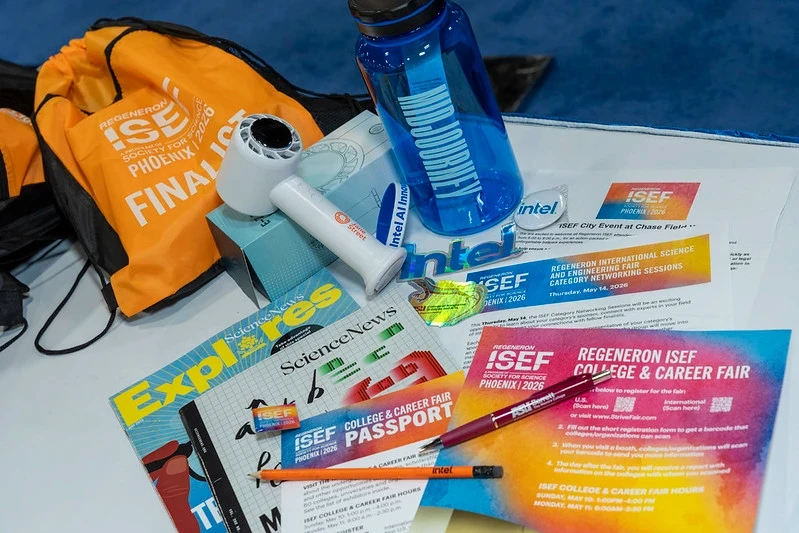
Participating in the Regeneron International Science and Engineering Fair (ISEF) is a prestigious opportunity that opens doors to academic and professional pathways well beyond high school. Regarded as the most competitive precollegiate science fair in the world, ISEF isn't something you enter directly — you earn your place by succeeding at the regional and state levels first.
This guide walks you through everything you need to know to earn a spot at ISEF and give yourself a real shot at winning.
Locate Your Regional Science Fair
Before you plan anything else, find your regional science fair and map your timeline around it. This step matters more than most people realize: the amount of time you have between now and your fair dictates which project ideas are actually feasible.
The easiest way to find yours is with sciencefair.io's Find a Fair tool. Enter your location and it points you to your affiliated regional fair.
Step-by-Step Guide to Your Project
1. Initial Planning and Research
Identify your passion. Start with a scientific area that genuinely excites you. Real interest is what carries you through the long stretches of a project, so think about the problems you actually care about and how research could help solve them.
Conduct preliminary research. Run a literature review to understand the current state of work in your area. This helps you spot the gaps your project could fill and makes sure your idea is original and relevant rather than a repeat of what's already been done.
Formulate a research question. Turn that reading into a specific, clear, and feasible question. A strong question guides the entire project — and "feasible" matters as much as "interesting," since you need to be able to investigate it with the resources you actually have.
2. Designing Your Project
Develop a hypothesis. Build a testable hypothesis from your research question. A well-defined hypothesis focuses your work and makes designing experiments far easier.
Create a detailed plan. Map out your methodology, materials, and timeline in full, accounting for every variable and control your investigation needs in a research plan. Build in some redundancy too — experiments rarely go perfectly the first time, and a little slack in your timeline saves you later.
Seek feedback early. Before you run a single experiment, get input from mentors, teachers, or professionals in your field. They can tell you whether your approach is sound and whether you're working on something that will genuinely add value — a conversation that's far cheaper before you've invested months of work than after.
3. Conducting Your Research
Gather materials and resources. Collect everything you need before you begin. If your school lacks equipment, reach out to local universities, research institutions, or online platforms. It's worth contacting these places regardless, since they're full of experts who may be willing to give feedback — cold-emailing is tough, but the payoff can be significant.
Perform your experiments. Follow your plan and keep meticulous records of every procedure, observation, and result in a lab notebook. Accurate records are essential for analysis and for anyone trying to reproduce your work. If you're in a field like math where there's no traditional experiment, apply the same care to how you derive and document your results.
Analyze your data. Use appropriate statistical tools to look for patterns and relationships that support or challenge your hypothesis. Rigorous analysis is what turns raw results into credible conclusions — and credibility is what judges reward.
4. Preparing Your Presentation
Write your abstract. Craft a clear, concise summary of your research question, methodology, results, and conclusions. Your abstract is often a judge's first impression, so make it capture the essence of your project.
Create a standout poster. Design charts, graphs, and visuals that communicate your findings at a glance. Strong visual aids make complex information accessible and are one of the fastest ways to draw judges in.
Practice your presentation. Build a polished pitch that moves logically from introduction to conclusion, then rehearse it repeatedly in front of different audiences. Each practice run builds confidence and surfaces the gaps you can't see on your own.
5. Advancing to State and National Levels
Analyze feedback. After each competition, study the judges' comments closely. This feedback is a roadmap for improvement, and using it well is how students climb through successive levels.
Refine your project. Strengthen your work based on what you learn — that might mean more experiments, sharper data analysis, or better presentation materials.
Network with peers and mentors. Take full advantage of the people around you at every fair. It's easy to get so wrapped up in your project that you miss this, but the connections and insights you gain are one of the biggest benefits of competing in the first place.
6. Final Preparations for ISEF Qualification
Perfect your presentation. As you head into state and national competition, focus on making your presentation clear, concise, and compelling — and rehearse answers to the questions judges are likely to ask.
Stay organized and focused. Keep your materials in order, hit every deadline, and hold onto a positive attitude through the grind.
Leverage online resources. Instructional videos, forums, workshops, and webinars can all sharpen your knowledge and skills as you prepare.
Qualify for ISEF with ScienceFair
Qualifying for ISEF is a testament to your hard work, dedication, and passion for science. Follow these steps, and you'll meaningfully improve your chances of getting there.
If you'd like guidance along the way, ScienceFair's mentors have competed in and won these exact competitions, and they work with students at every stage — from first idea to final presentation. You might also find it useful to learn how to get advice from a science fair winner, or if your project leans that direction, our ultimate guide to neuroscience competitions for high school students and guide to the BCA Research Expo.
Ready to make your run at ISEF? Schedule a call with our academic advisor.

Related Articles
How to Qualify for ISEF: A Step-By-Step Guide
Everything you need to qualify for ISEF, the world's top science fair — from finding your regional fair to building a project and presentation that advance.
Read article →
How to Qualify for ISEF: A Step-By-Step Guide
Everything you need to qualify for ISEF, the world's top science fair — from finding your regional fair to building a project and presentation that advance.
Read article →
How to Qualify for ISEF: A Step-By-Step Guide
Everything you need to qualify for ISEF, the world's top science fair — from finding your regional fair to building a project and presentation that advance.
Read article →